Nina Winchester and Andrew Winchester’s Marriage
The HousemaidNina Winchester and Andrew Winchester’s marriage is first presented as a convincing picture of affection, then unsettled by fertility troubles and the disclosures that follow. Millie Calloway’s view of the couple changes as she watches them move from public tenderness and shared plans toward grief, awkward distance, and a relationship entangled with her own affair with Andrew.
Affection and the Household’s First Impression
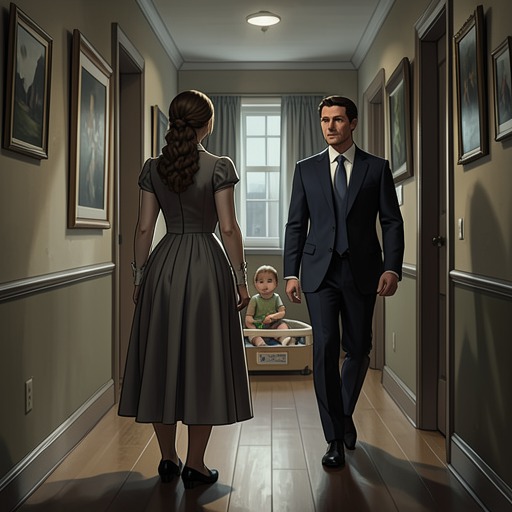
At first, Millie sees Andrew as a loving husband. Before leaving for a nine-thirty meeting in the city, he straightens his gray tie, kisses Nina lingeringly, and squeezes her shoulder; at the door, he blows her a kiss. His eight-figure net worth makes him unusually wealthy, but Millie also reads him as down-to-earth. The gestures seem so ordinary and tender that she tells Nina her husband seems nice. Nina responds with a dark, suspicious look and asks whether Millie really thinks so. That brief exchange complicates Millie’s confident first impression: she sees evidence of affection, while Nina’s reaction suggests that the marriage may not look the same from within it.
For a time, the couple’s attention turns toward the possibility of another child. They have been nervous and excited about Nina’s appointment with a fertility specialist, after she has undergone a series of tests. Millie hears them discuss IVF, which they can afford, and plans to turn the guest room into a nursery. She cannot tell whether Nina or Andrew is more eager. Their shared anticipation gives the marriage a forward-looking, domestic intimacy: they are not merely hoping for a pregnancy, but imagining how a new child would change their home.
Fertility News and Marital Strain
The appointment is followed by a sharp change in mood. Nina retreats upstairs with a pounding headache, stomping up the stairs and slamming the bedroom door. Andrew sinks onto the leather sofa and says the appointment went badly. Millie sits beside him to ask if he is all right, and he admits he is not. The contrast with the couple’s earlier excitement makes the disappointment legible before its details are fully clear: a nursery they had been planning is suddenly shadowed by news neither of them can easily absorb.
Later, Millie hears Nina blame herself for the couple’s inability to have a baby. Nina says that Andrew could have a child with a younger woman and that he would be better off without her. Andrew tries to reassure her that it is not her fault. The exchange shows how fertility has become not only a medical question but a judgment Nina turns against herself, measuring her worth as a wife against her capacity to bear a child. It also brings age into the marriage’s emotional landscape: Andrew is younger, and Nina fears that this difference makes her replaceable.
Andrew explains to Millie that Nina is older than he is and that, early in their marriage, she had issues that made him uncomfortable trying for a baby. They waited, and now he regrets the lost time. When he first refers to loving Nina in the past tense, he immediately corrects himself, insisting that he loves her and that they still have each other. The slip does not prove that his love has ended, but it exposes how difficult it is for him to speak about the marriage without revealing uncertainty. His correction is both reassurance and evidence that the reassurance has become necessary.
An Attempt at Repair, and the Distance That Remains
Nina and Andrew plan to stay overnight at The Plaza Hotel while Cecelia stays with a friend. Nina describes the trip as something she and Andrew need, and she looks forward to it. The arrangement could offer time away from the household and a chance to reconnect after the fertility appointment. Yet Millie notices that, since the appointment and their argument, the couple have been awkwardly polite with one another. Nina seems distracted enough to button her white blouse incorrectly. Millie notices the mistake but keeps quiet, expecting Nina would yell if she pointed it out.
The planned night away therefore carries two meanings at once. Nina presents it as a welcome chance to be together; from Millie’s position inside the house, it looks like an effort to bridge a distance that has not disappeared. The discrepancy is visible in small domestic details rather than a direct account from either spouse: the careful politeness, the missed button, and Millie’s decision not to speak. The marriage’s strain is private, but it alters the atmosphere of the household around them.
Millie’s Affair and the Marriage’s Wider Consequences
The marriage also becomes the context for Millie’s affair with Andrew. Afterward, Millie imagines that Nina might welcome a chance to have her removed without having to dismiss her directly, and might see the prospect as revenge for Millie having slept with her husband. This is Millie’s fearful interpretation, not a confirmed plan by Nina. Still, it shows how the affair changes the meaning of the household: Millie is no longer simply observing a married couple’s difficulties but is implicated in them, and she worries that Nina could turn her position as employer against her.
That fear is sharpened by Millie’s precarious parole circumstances. Three weeks after moving in with the Winchesters, she schedules a meeting with her parole officer for her day off because she does not want the household to know where she is going. She has concealed that she was fired from her waitressing job and evicted from her apartment; she is living in her car, and both that situation and lying to her officer could violate parole. She once lied that she had quit rather than been fired, because the employer had agreed not to involve the police if she left quietly. Millie fears that a police complaint could send her back to prison for the remaining five years of her sentence. These facts do not explain the marriage itself, but they show why its entanglement with her affair carries consequences far beyond hurt feelings: the balance of security between the wealthy couple and their live-in employee is profoundly unequal, and Millie has little room for error.